Published by:
CGP EDU Academic Team
Published on: September 12, 2026
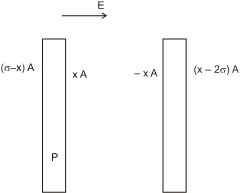
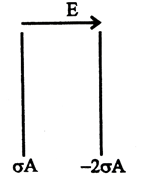
Two thin conducting plates (very large) parallel to each other carrying total charges σA and -2σA respectively (where A is the area of each plate), are placed in a uniform external electric field E as shown. Find the surface charge on each surface.
Text Solution
Verified by ExpertsThe correct answer is:
C
To find the surface charge on each surface, we analyze the situation based on the superposition principle of electric fields due to the plates and the external electric field.
Step 1: Identify the charges on the plates.
The left plate has surface charge density σA and the right plate has surface charge density -2σA.
Step 2: Calculate the electric fields due to the charged plates.
The electric field due to a uniformly charged infinite plane sheet is given by:
$$E = \frac{\sigma}{2 \epsilon_0}$$
where σ is the surface charge density and ε₀ is the permittivity of free space.
For the left plate with charge σA:
$$E_{left} = \frac{\sigma A}{2 \epsilon_0}$$ in the direction away from the plate.
For the right plate with charge -2σA:
$$E_{right} = -\frac{2\sigma A}{2 \epsilon_0} = -\frac{\sigma A}{\epsilon_0}$$ in the direction towards the plate.
Step 3: Calculate the net electric field between the plates.
The net electric field in the region between the plates is:
$$E_{net} = E_{left} + E_{right} = \left(\frac{\sigma A}{2 \epsilon_0}\right) + \left(-\frac{\sigma A}{\epsilon_0}\right) = -\frac{\sigma A}{2 \epsilon_0}$$
Step 4: Since the external electric field E is acting in the same direction as the net field calculated above, we find the induced charges.
The effective charge densities will adjust to maintain equilibrium based on the external electric field. By balancing the fields, we can deduce that:
- The surface charge on the left surface remains at σA (due to the external field's influence).
- The surface charge on the right surface must balance the total charge density (initially -2σA) and should adjust to achieve equilibrium, which leads to a new surface charge density:
$$\sigma_{right} = -\frac{3\sigma A}{2}$$
In conclusion, we have:
Left Plate: +σA
Right Plate: -3σA
Therefore, the magnitudes of the surface charges after considering the distribution are:
Left Plate = σA; Right Plate = -3σA. Hence the answer is option C.
Step 1: Identify the charges on the plates.
The left plate has surface charge density σA and the right plate has surface charge density -2σA.
Step 2: Calculate the electric fields due to the charged plates.
The electric field due to a uniformly charged infinite plane sheet is given by:
$$E = \frac{\sigma}{2 \epsilon_0}$$
where σ is the surface charge density and ε₀ is the permittivity of free space.
For the left plate with charge σA:
$$E_{left} = \frac{\sigma A}{2 \epsilon_0}$$ in the direction away from the plate.
For the right plate with charge -2σA:
$$E_{right} = -\frac{2\sigma A}{2 \epsilon_0} = -\frac{\sigma A}{\epsilon_0}$$ in the direction towards the plate.
Step 3: Calculate the net electric field between the plates.
The net electric field in the region between the plates is:
$$E_{net} = E_{left} + E_{right} = \left(\frac{\sigma A}{2 \epsilon_0}\right) + \left(-\frac{\sigma A}{\epsilon_0}\right) = -\frac{\sigma A}{2 \epsilon_0}$$
Step 4: Since the external electric field E is acting in the same direction as the net field calculated above, we find the induced charges.
The effective charge densities will adjust to maintain equilibrium based on the external electric field. By balancing the fields, we can deduce that:
- The surface charge on the left surface remains at σA (due to the external field's influence).
- The surface charge on the right surface must balance the total charge density (initially -2σA) and should adjust to achieve equilibrium, which leads to a new surface charge density:
$$\sigma_{right} = -\frac{3\sigma A}{2}$$
In conclusion, we have:
Left Plate: +σA
Right Plate: -3σA
Therefore, the magnitudes of the surface charges after considering the distribution are:
Left Plate = σA; Right Plate = -3σA. Hence the answer is option C.
Prepare Smarter with CGP Edu
Get practice questions, solutions, and test series in one place.
Write a Review
Share your experience with this question and solution.
Commentary
Send your comment, doubt, correction, or feedback to admin.
Similar Questions
Explore conceptually related problems
The electric field near the conducting surface of a uniform charge density σ will be –
An uncharged conductor A is brought close to another positive charged conductor B, then the charge …
The fig. shows lines of constant potential in a region in which an electric field is present. The v…
The electric charge in uniform motion produces –
Which of the following represents the correct graph for electric field intensity and the distance r…
A neutral metallic object is placed near a finite metal plate carrying a positive charge. The elect…